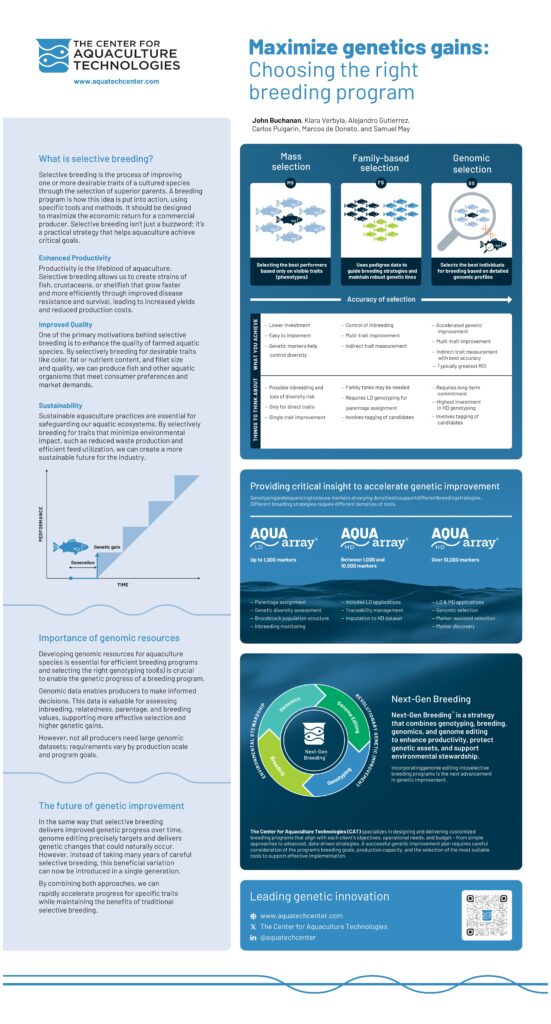
Selective breeding is one of the most powerful tools available to aquaculture producers, driving improvements in growth, survival, disease resistance, robustness, and overall production performance. However, because breeding programs differ in their goals, production environments, and operational constraints, there is no one-size-fits-all approach.
Choosing the right breeding strategy requires balancing breeding objectives, available resources, operational constraints, and the level of genetic gain required to achieve commercial goals. While some programs can achieve meaningful progress through simple selection approaches, others may benefit from more advanced technologies that deliver greater accuracy and faster rates of improvement.
In this poster recently presented by the team, we explore the range of breeding programme options available to aquaculture producers, from low-investment approaches such as mass selection through to family-based breeding programs and genomic selection. We examine the strengths, limitations, and practical considerations of each approach to help producers understand which strategy is best suited to their operation.
The poster also highlights the critical role of both phenotypic and genotypic data in driving genetic gain. As breeding objectives become more complex and producers seek improvements across multiple traits simultaneously, access to accurate performance and genomic information becomes increasingly important.
Whether you are establishing a new breeding program or looking to optimise an existing one, understanding the full range of available tools is essential to maximising return on investment and achieving sustainable long-term genetic improvement.
Download the poster to learn how different breeding program strategies compare and how to select the approach that best aligns with your goals, resources, and long-term vision.