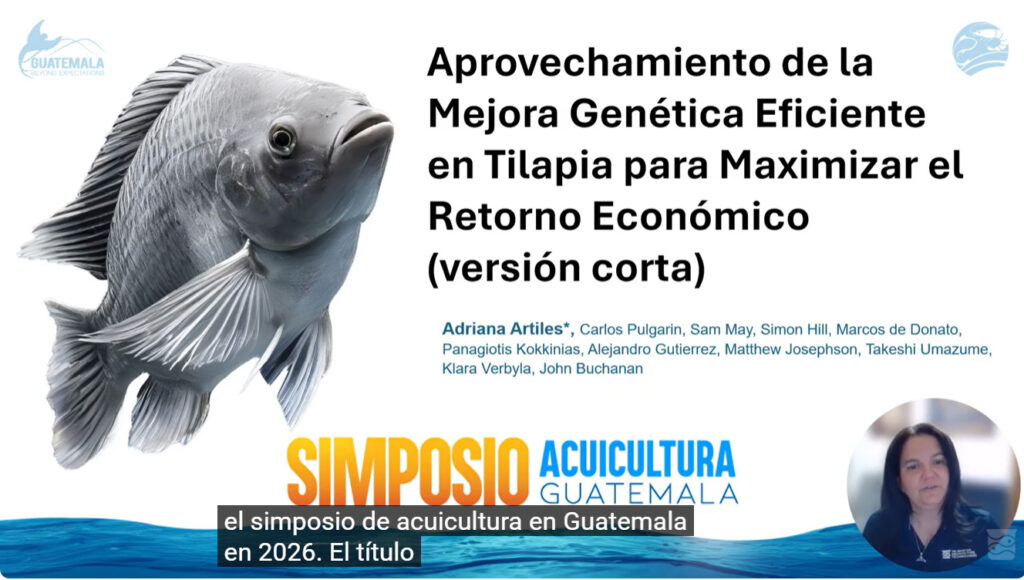
Turning genetic improvement into measurable value for tilapia producers
Genetic improvement is no longer simply a long-term investment for tilapia producers. When the right strategy, tools and breeding objectives are brought together, genetics can become a powerful driver of productivity, efficiency and economic value.
At the 2026 Aquaculture Symposium in Guatemala, CAT’s Dr. Adriana Artiles explored how tilapia producers can use efficient genetic improvement strategies to maximize their return on investment in her presentation, “Aprovechamiento de la Mejora Genética Eficiente en Tilapia para Maximizar el Retorno Económico.”
Adriana’s presentation addressed some of the key questions producers face when considering a genetic improvement programme: What can I improve? How should I do it? Which breeding strategy and tools are right for my objectives? How long will it take? And what return can I expect?
From genetic potential to economic value
The presentation highlights that successful breeding programs should start with clearly defined production objectives and a strong genetic foundation, including sufficient genetic diversity and phenotypic variation. From there, producers can select the breeding approach and molecular tools that best match their objectives, budget and production system.
Adriana compares three fundamental approaches — mass selection, family/pedigree selection and genomic selection — showing how increasing the precision and intensity of selection can accelerate genetic gain. For tilapia, where generation intervals can be relatively short, this creates an opportunity to deliver meaningful improvements over just a few production cycles.
The presentation also explores how genotyping supports breeding programs, from managing genetic diversity and assigning parentage to enabling genomic selection and marker-assisted selection. Importantly, the optimal marker density depends on the specific breeding objectives — reinforcing the value of selecting the right genomic tool rather than simply choosing the highest-density option.
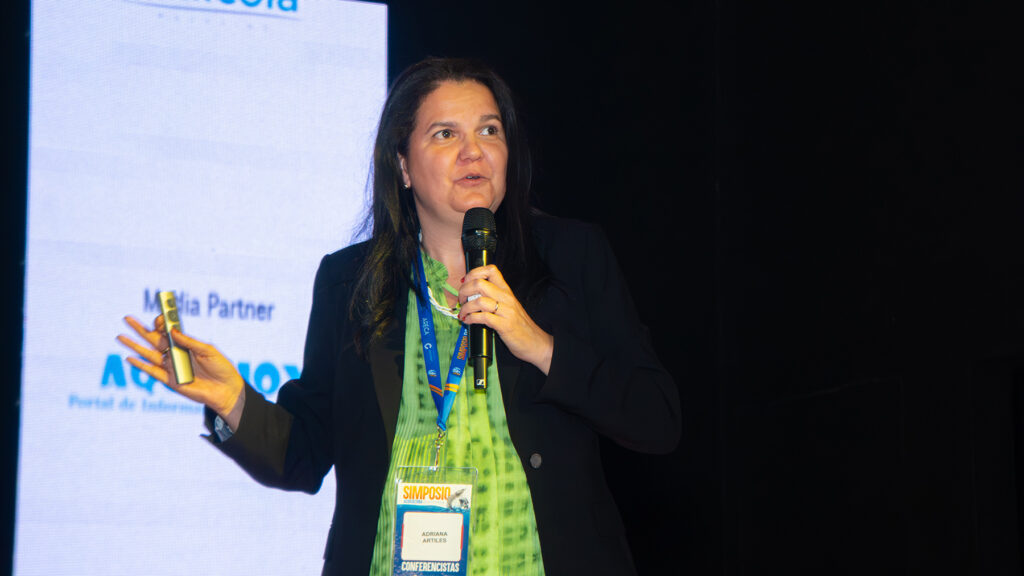
Adriana Artiles
The next step in genetic improvement: Integrating genome editing into established breeding programs.
CAT’s strategic partnership with Brazilian Fish, announced in February 2025, was highlighted as an example of a commercial-scale tilapia producer integrating genome editing into their breeding program. Adriana explains how genome editing can accelerate the introduction of desirable traits that would otherwise require multiple generations of conventional selection.
The presentation highlights the potential of combining genome editing with genomic selection to increase the speed and precision of genetic improvement, while creating additional economic value for producers.
For producers, genetics deliver value when the right strategy is applied to the right production objectives, driving measurable improvements in profitability.
Watch the 10-minute recording in Spanish
View Adriana Artiles’ talk from Simposio de Acuicultura en Guatemala 2026 to learn how an effective breeding strategy can help tilapia producers maximise gain and economic return: https://www.youtube.com/watch?v=yyld1Uk5Nu8