
The South American country became the world’s leading shrimp exporter with surprisingly little expansion in farming area
Ecuador’s shrimp industry offers a striking lesson in what productivity can do.
In 2000, when the industry was reeling from white spot disease, the country exported just 38,905 metric tons of shrimp. By 2024, its exports had reached 1.214 million mt, worth almost $7 billion.
Shrimp production grew far faster than the area devoted to farming. Ecuador had 178,072 hectares under production in 1995 and 232,071 ha by 2024, an increase of about 30%. Over roughly the same period, shrimp exports increased more than thirteenfold.
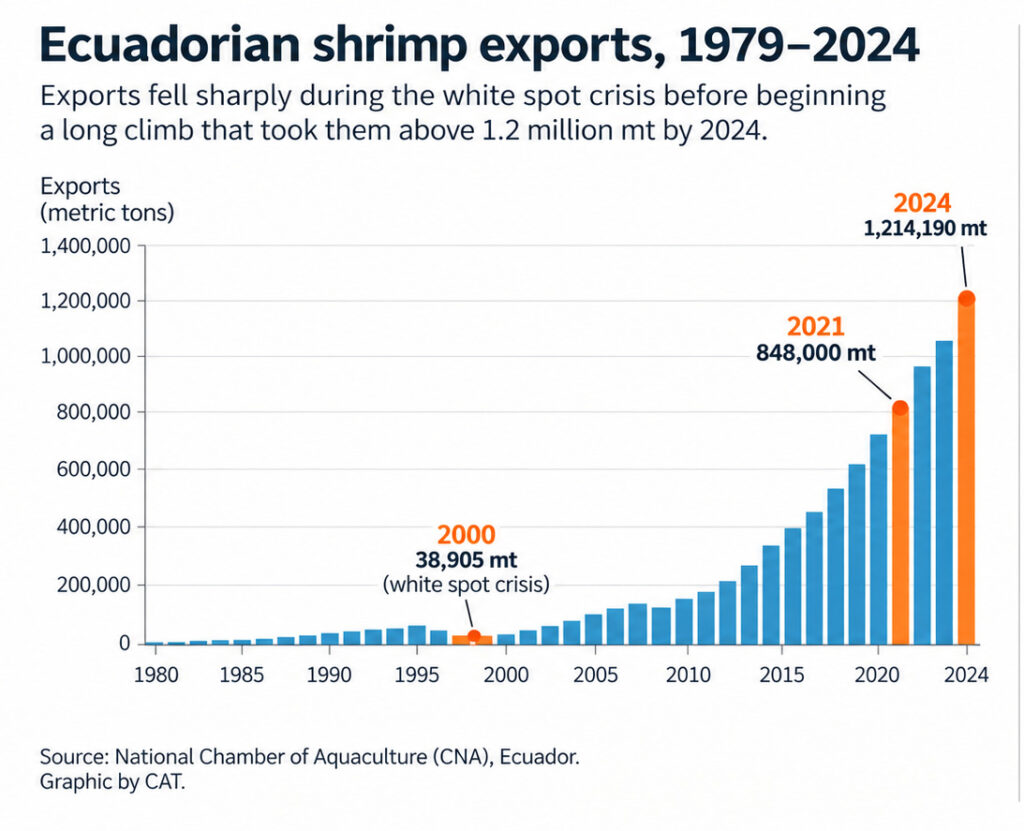
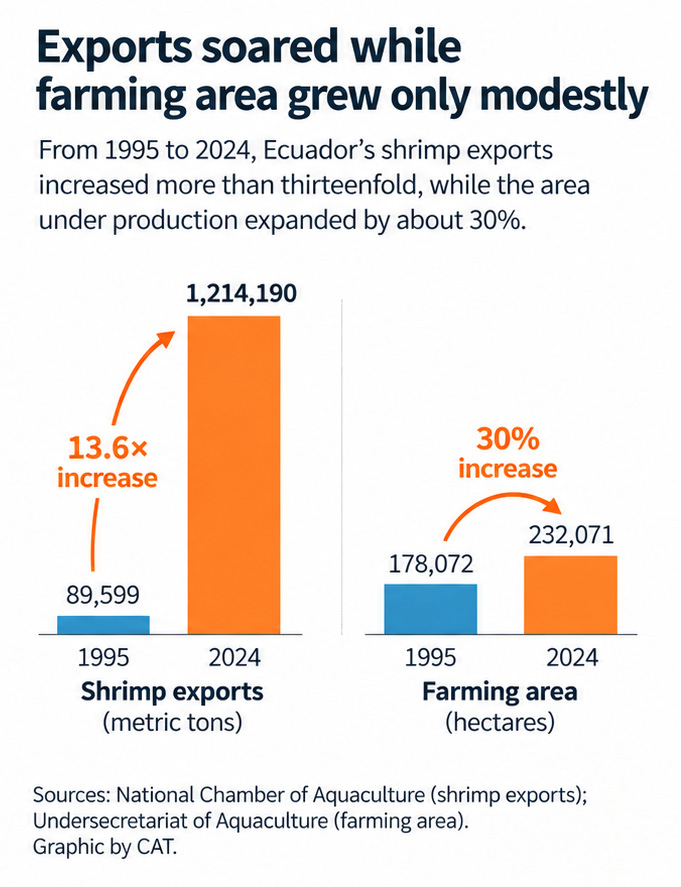
Ecuador’s shrimp exports reached 1.214 million metric tons in 2024, more than 13 times the volume exported in 1995. Photo: CAT
How did Ecuador manage to produce so much more shrimp without a comparable increase in pond area?
There is no single answer. Improvements in genetics, feed, health, technology and farm management have all contributed to the industry’s development.
But one part of the story deserves particular attention: the value of investing in genetic improvement as a long-term strategy for making better use of existing production capacity.
The cumulative value of breeding was being highlighted even before Ecuador’s first large-scale commercial genomic-selection program was launched (Rocha et al., 2022). Speaking at Aquavision in 2018, then-Global Aquaculture Alliance president George Chamberlain argued that breeding could deliver gains unlike other improvements in aquaculture.
“I want to make the case with you that there’s nothing we can do in any aspect of aquaculture that has the cumulative benefit year after year as breeding,” Chamberlain said. He pointed to growth and resistance to multiple pathogens among the traits breeding could target, and singled out genetic resistance as a particularly valuable tool for shrimp. “The Ecuadorians have certainly demonstrated that” (Mayer, 2018).
Producing more from existing acreage
Much of the increase in productivity has come from producing more biomass per crop and, where shorter production cycles allow, more crops from the existing farming area.
Faster growth reduces the time shrimp spend in grow-out, while higher survival leaves more biomass to harvest. Nursery systems allow farmers to transfer larger animals into ponds. Automatic feeders, pumps and better feeds have also changed how farms manage the production cycle.
The scale of the productivity gain is striking. During the white spot crisis, output fell to around 215 kilograms per hectare per year. Based on 2024 production and farming-area figures, productivity has since reached about 5.23 mt/ha/year.
The economics help explain why those gains matter. Industry data shows about 85% of farm costs per hectare per cycle are variable. Feed alone accounts for around 65% of those variable costs.
A shrimp that reaches harvest size sooner or survives at a higher rate can therefore change the economics of a crop. Feed efficiency is crucial when feed represents such a large share of production costs. Shorter production cycles can create another advantage by allowing farms to turn ponds more frequently.
Ecuador’s gains have come alongside changes in feeding, nutrition and farm technology. Feeding by demand, functional nutrition, mechanization, automation and digitalization have all become part of the industry’s development.
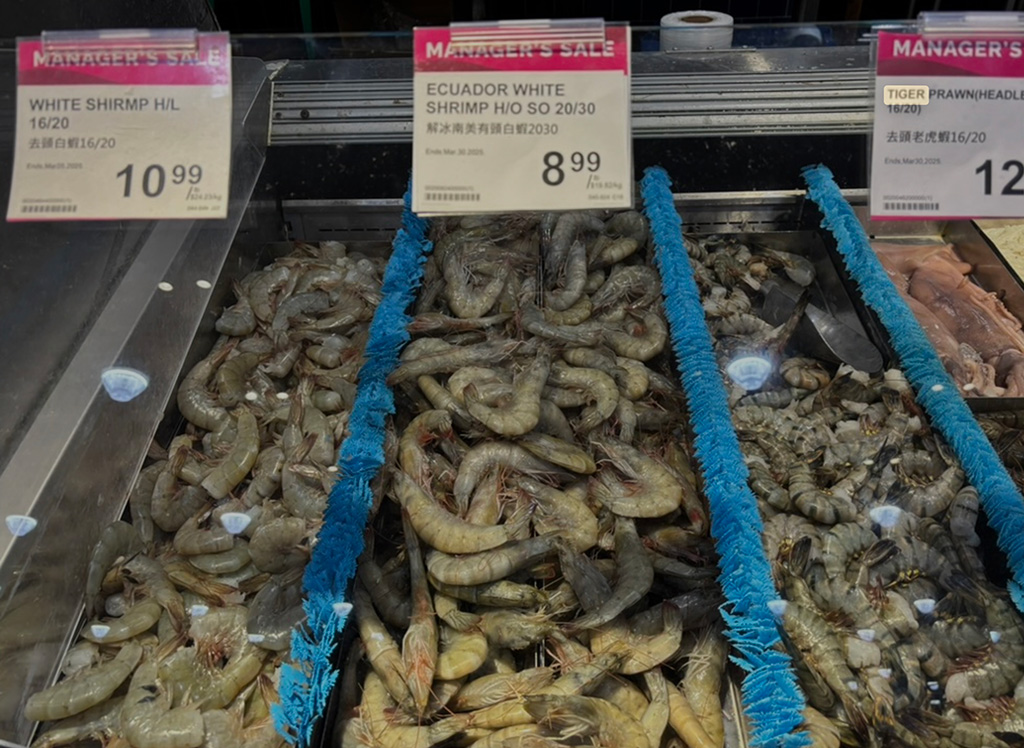
Ecuadorian white shrimp on sale at a Vancouver supermarket. Photo: Liza Mayer
Genetics in a changing production system
Following the white spot outbreak, Ecuador largely built its breeding programs around locally sourced animals that had performed and survived under the country’s farming conditions, rather than relying on imported specific-pathogen-free broodstock, as some other shrimp-producing countries have done.
That choice became a distinctive feature of Ecuador’s genetic strategy. Rather than separating selection from the realities of commercial production, breeding programs could use local disease pressure and farming conditions to help identify animals capable of performing in the environments their offspring would encounter.
One approach was All Pathogen Exposed (APE) selection under commercial conditions. This made the production environment itself part of the selection process and also allowed breeding programs to account for genotype-by-environment (GxE) effects — differences in how animals’ genetics perform under different production conditions.
This gives breeding programs direct information about which animals perform best under commercially relevant conditions. The animals selected as parents influence the performance of future generations, allowing programs to gradually improve the genetic potential of the population.
Large farming companies tend to have relatively standardized feeding practices, nursery strategies and farm management. This allows breeding programs to select animals for the conditions their commercial offspring will actually face, including disease pressure, salinity, feeding and production practices.
Over successive generations, selection could produce animals increasingly suited to the production systems in which they would be farmed.
From selection to genomics
Ecuador’s genetic strategy has continued to evolve. Localized mass selection and family-based approaches were followed by molecular tools and, more recently, genomic selection.
Beginning in 2020, a large-scale commercial genomic selection program was implemented in Ecuador with support from the Center for Aquaculture Technologies (CAT), using genomic data primarily to improve survival while maintaining progress in growth. The program marked a shift from using genetic markers mainly for parentage and diversity management toward using genome-wide information directly in selection decisions under commercial production conditions (Rocha et al., 2022).
Genomic selection gives breeders more information about genetic relationships among animals and can improve the accuracy of identifying candidates likely to pass desirable traits to the next generation. This becomes particularly useful when programs select for several economically important traits at once, while maintaining enough genetic diversity for future improvement and for responding to new disease or environmental challenges.
CAT’s contribution to this transition has included developing and applying high-density genotyping tools for Penaeus vannamei. The AQUAArray HD vannamei platform contains approximately 50,000 SNP markers and was evaluated in an Ecuadorian breeding population in 2021 and 2023, providing a practical platform for genomic selection and genome-wide association studies.
The value of these tools comes from combining genomic relationships with commercial performance records, helping breeders more accurately distinguish animals with superior genetic potential, including among close relatives.
In 2025, a new tool with 63,000 SNPs was used for genomic selection, expanding the approach across different environmental conditions and ages to select for growth and survival.
Evidence from Ecuadorian commercial populations also shows that there is genetic variation available to exploit. A 2023 study of an industrial Ecuadorian P. vannamei breeding program reported moderate heritability for growth traits of 0.25-0.34. In practical terms, that means a meaningful portion of the differences in growth observed among the shrimp was attributable to inherited genetic differences and could therefore respond to selection under local commercial conditions (Shin et al., 2023).
The economics of genetic gain
Ultimately, the commercial case for genetic improvement rests on what better-performing animals do on the farm. Its value can appear through:
- Higher harvest biomass
- Improved survival and more saleable shrimp
- Faster growth and shorter production cycles
- Better feed efficiency
- Improved performance under local disease or environmental conditions
- Greater consistency across production cycles
These improvements can affect the economics of every crop. But breeding has another distinctive characteristic: genetic gains can be carried into subsequent generations and built upon.
Ecuador’s industry also developed the financial capacity to keep investing in genetics and farm technology. As some shrimp businesses grew, they acquired greater resources for reinvestment. Larger, more integrated operations can generally sustain these investments more readily than fragmented industries dominated by smaller producers.
In Ecuador, continued reinvestment accompanied improvements in genetics, feeding, automation and other parts of the production system.
The lesson is that genetic improvement is not a one-off intervention. It requires continued selection, measurement and reinvestment if gains are to accumulate over time.
What Ecuador’s experience shows
None of this means Ecuador’s extraordinary production growth can be assigned to genetics, much less to genomics alone. Farm productivity also reflects improvements in feed, health, automatic feeding, nursery practices, transfers, technology and management.
Genetic improvement also depends on the production system around the animal. Genomic information is most useful when breeding programs have the populations, performance data and scale needed to put it to work.
What distinguishes Ecuador is how those elements came together. Its breeding programs began with animals tested under demanding local commercial conditions. As the programs matured, increasingly sophisticated genetic tools were added to identify and combine desirable traits with greater accuracy. Genomics did not replace the strategy that came before it; it added precision to it.
Ecuador’s growth was built through sustained improvements in how shrimp were bred and farmed. Over time, those gains allowed the industry to produce vastly more shrimp without a comparable expansion of its farming footprint.
For producers elsewhere, Ecuador’s experience cannot simply be replicated. Genetic improvement has to take account of the environment, production challenges, scale and culture systems in which the animals will be farmed.
There is no single genetic solution for every producer. Ecuador’s experience instead shows what can happen when genetic improvement becomes a long-term part of the production strategy — and when each generation becomes the starting point for improving the next.
References
Mayer, L. (2018). Breeding innovations hold key to shrimp farming’s future. Aquaculture North America, July 23, 2018.
Rocha, J.L. et al. (2022). World’s first fully integrated Pacific white shrimp genomic selection program established in Ecuador. Responsible Seafood Advocate.
Shin, H.S. et al. (2023). Genetic parameters for growth and morphological traits of the Pacific white shrimp Penaeus vannamei from a selective breeding programme in the industrial sector of Ecuador. Aquaculture Reports 31:101649.