
Genome editing is a practical, scalable tool that enables producers to unlock substantial gains in productivity, resilience, and sustainability – faster than ever before.
Unlike conventional selective breeding, which builds incremental improvement over generations, genome editing introduces significant performance gains in a single generation.
Genome editing strengthens established breeding programs, integrating seamlessly into commercial production to accelerate genetic gains and deliver faster value across the production chain.
A Tool That Delivers Across Many Traits
Genome editing can be applied across a wide range of traits that matter to every stakeholder: producers, regulators, and consumers alike.
These include:
- Growth performance
- Yield and fillet percentage
- Feed efficiency
- Disease resistance
- Gender determination
- Pigmentation
- Monosex
- Sterility
The Impact is Quantifiable
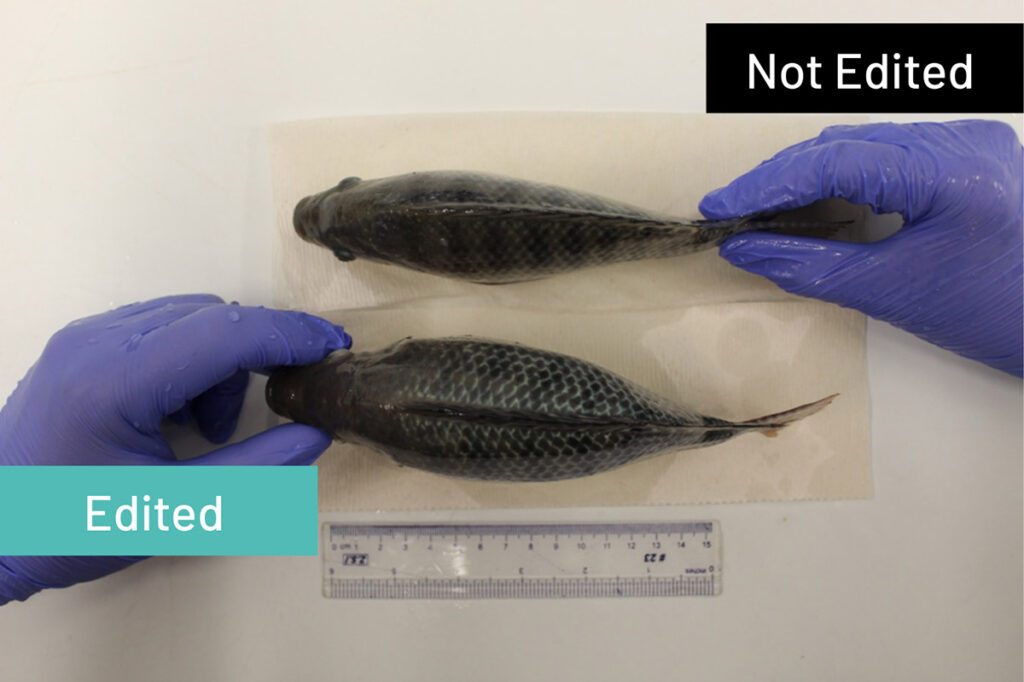
In tilapia, for example, CAT has recorded single-gene edits that have delivered up to 48% improvement in growth performance compared to non-edited siblings. That level of gain represents a meaningful shift in farm productivity, with the potential to shorten harvest cycles, improve turnover, strengthen margins, and enhance access to healthy sources of protein.
More Than Growth: Built for Sustainable Production
Genome editing can not only deliver performance gains but can also provide environmental, regulatory, and commercial confidence.
An important part of this innovation is the ability to address containment concerns. Genome editing enables the reliable production of 100% sterile fish, addressing multiple challenges simultaneously:
- Prevents reproduction of escaped farmed fish with wild populations
- Protects proprietary genetics and encourages investment
- Addresses environmental and regulatory concerns
- All whilst redirecting reproductive energy toward growth
Speed Changes Everything
One of the defining advantages of genome editing is speed.
Traditional breeding improves performance from generation to generation. Genome editing can introduce a significant improvement in a single generation. Gains that selective breeding can then continue to build upon.
This acceleration has the potential to increase genetic progress by orders of magnitude compared to conventional methods. For producers facing evolving disease pressures, feed cost volatility, and sustainability demands, speed matters.
Built for Commercial Scale
Reports show that more than 25 aquaculture species have already been successfully gene-edited, with tilapia leading research efforts due to its short generation time and robustness.
But delivering genome editing at a commercial scale requires more than scientific proof of concept. It requires:
- High-throughput editing methods
- Efficient egg processing
- Integration into breeding programs
- Careful management of relatedness and inbreeding
- Robust genotyping and tracking systems
CAT’s recent advancements have achieved over 95% editing efficiency across thousands of eggs per day, demonstrating that genome editing is not just viable, it’s scalable. This progress was reinforced when CAT announced in 2025 their collaboration with tilapia producer Brazilian Fish, marking the first introduction of commercial-scale genome-edited tilapia in Brazil and confirming that integration into breeding programs is already underway.