
At the start of the year, Sabrina Sauri, Research Associate at CAT, presented at PAG33 – the International Plant and Animal Genome Conference – one of the world’s leading forums for genomic innovation.
Her poster showcased another example of how CAT is contributing to the future of aquaculture breeding through a powerful combination of laboratory innovation and advanced bioinformatics.
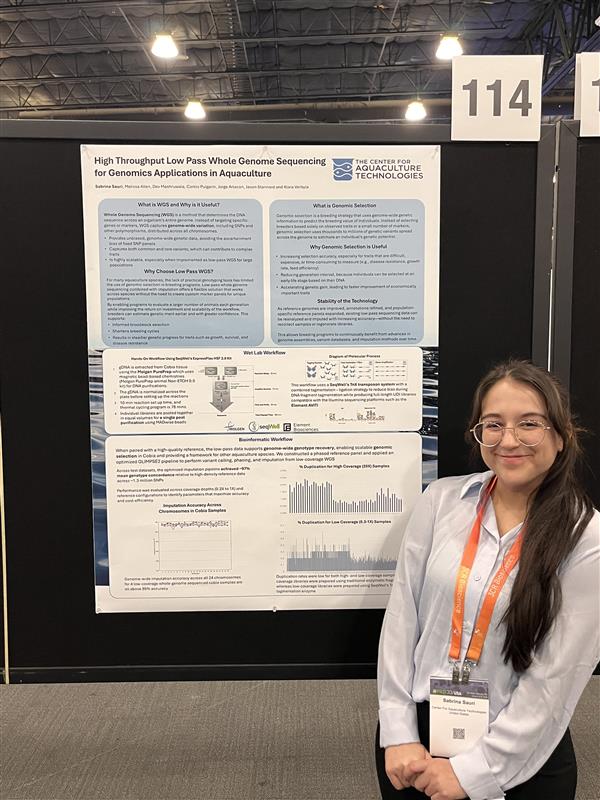
Sabrina Sauri, Research Associate at CAT
The project focused on developing a high-throughput low-pass Whole Genome Sequencing (WGS) pipeline for Cobia (Rachycentron canadum), an emerging aquaculture species with significant commercial potential. But the implications reach far beyond a single species, offering a scalable genomic framework for aquaculture programs worldwide.
What Is Whole Genome Sequencing – and Why Does It Matter?
Whole Genome Sequencing (WGS) determines the DNA sequence across an organism’s entire genome. Unlike traditional genotyping approaches that target predefined markers, WGS captures genetic variation across all chromosomes, including both common and rare variants.
This genome-wide perspective provides several key advantages:
- Unbiased genetic insight without the limitations of fixed SNP panels
- Detection of variants linked to complex traits such as growth and disease resistance
- A scalable platform for large breeding populations
For aquaculture, where many emerging species still lack robust genotyping tools, these advantages are transformative.
The Power of Low-Pass Sequencing
While high-coverage sequencing can be costly at scale, CAT’s approach uses low-pass WGS, sequencing genomes at shallow coverage and then applying advanced imputation methods to recover accurate genome-wide genotypes.
This strategy allows breeding programs to analyse far more animals per generation while maintaining high data quality. The result is faster, smarter decision-making that supports:
- More informed broodstock selection
- Shorter breeding cycles
- Steady genetic improvement in key traits like survival, growth, and disease resistance
By improving scalability and return on investment, genomic selection becomes accessible even for species without custom marker panels.
Innovation from Bench to Bioinformatics
CAT’s workflow integrates both laboratory and computational expertise. The team implemented an optimized library preparation method using a TnX transposon system, combining tagmentation and ligation to minimise positional bias while increasing throughput and reducing hands-on time.
Importantly, the value of low-pass sequencing continues to grow over time. As reference genomes improve and population datasets expand, existing data can be reanalysed to achieve even higher accuracy, without recollecting samples or regenerating libraries.
A Scalable Future for Aquaculture Genomics
This work demonstrates more than a technical achievement; it highlights CAT’s ability to deliver end-to-end genomic solutions, from experimental design and wet-lab optimisation to advanced analytical pipelines.
By building efficient, scalable, and future-proof workflows, CAT is helping aquaculture producers unlock the full potential of genomic selection – accelerating sustainable production and genetic progress across species.